Can a general contractor do electrical work in Orange County? Only in a narrow, legally defined way, unless that same contractor also holds a separate C-10 electrical license. Mixing up the two credentials is one of the fastest ways to get a permit rejected or a project flagged mid-build.
The Short Answer: What Orange County Law Actually Allows
California splits construction licensing into classes, and a Class B General Building license does not automatically cover electrical self-performance. A Class B General Building Contractor license covers structures requiring at least two unrelated building trades or crafts, covering the majority of residential and commercial construction. Electrical work falls under its own specialty class: C-10.
A Class B general contractor without a C-10 can still manage a project where electricians are subcontracted, pull combined permits, and coordinate the trade. What they generally cannot do is wire a panel, run new circuits, or sign off on electrical work as if they were the licensed specialist. For projects in Irvine, Santa Ana, Anaheim, or anywhere else in the county, our general contractor team handles that coordination daily.
Class B vs. Class C-10: What Each License Actually Covers
| License Class | Primary Scope | Electrical Authority |
|---|---|---|
| Class B – General Building | Framing, structural work, multi-trade coordination | Limited to incidental/supplemental electrical tied to a larger contract |
| Class C-10 – Electrical Contractor | Wiring, panels, circuits, fixtures | Full electrical scope, any voltage, as prime contractor or sub |
An electrical contractor places, installs, erects or connects any electrical wires, fixtures, appliances, apparatus, raceways, conduits, solar photovoltaic cells or any part thereof, which generate, transmit, transform or utilize electrical energy in any form or for any purpose. That broad definition is exactly why the C-10 exists as its own license class instead of being folded into general building work.
The C-10 License: Requirements and What It Authorizes
Earning a C-10 isn't a paperwork formality. Requirements include passing a trade examination and having at least four years of journey-level experience in the electrical trade. Candidates also carry a CSLB surety bond and meet insurance requirements before the license is issued.
One detail most homeowners never hear: active C-10 contractors are required to maintain workers' compensation insurance or an approved Certification of Self-Insurance even if they have no employees, because C-10 is one of the classifications that cannot use CSLB's standard no-employee workers' compensation exemption. That single rule is why C-10 holders carry overhead costs that a bare handyman operation never will.
The C-10 is also unusually broad for a specialty license. It is one of the broadest specialty licenses, since most Class C licenses cover a narrow trade while the C-10 authorizes electrical work at any voltage. A general contractor who separately earns this classification becomes what the industry calls a dual-licensed contractor, legally able to self-perform electrical scope on their own projects.
BPC 7059: The "Incidental and Supplemental" Gray Area
This is where most online advice gets sloppy, and where a lot of GCs get burned. California Business and Professions Code Section 7059 states that nothing in the section prohibits a specialty contractor from taking and executing a contract involving two or more crafts or trades, if the work outside their licensed craft is incidental and supplemental to the work in which they are licensed.
The regulation that defines "incidental and supplemental" doesn't set a dollar figure at all. Work in other classifications is incidental and supplemental to the work for which a specialty contractor is licensed if that work is essential to accomplish the work in which the contractor is classified.
That's worth repeating, because several contractor-marketing sites online quote a specific dollar cap or percentage for this rule. The CSLB does not publish bright-line definitions of "incidental," leaving disputes to enforcement interpretation and, ultimately, administrative hearings. Anyone telling you there's a hard dollar ceiling on incidental electrical work is guessing. The real standard for 16 CCR Section 831 — read the actual regulation text here — is whether the electrical task is essential to finishing the job you're already licensed to do, not whether it falls under a specific invoice amount.
That means a Class B contractor replacing a junction box while framing a wall addition may be fine. A Class B contractor running a dedicated circuit to a new kitchen island as a standalone task usually isn't, regardless of the invoice total.
The $1,000 Handyperson Exemption Is a Different Rule Entirely
Homeowners and even some contractors confuse BPC 7059's incidental rule with the small-job exemption, and the two have almost nothing to do with each other. Assembly Bill 2622, effective January 1, 2025, allows an unlicensed person to complete small projects up to $1,000 without obtaining a contractor's license, as long as they do not hire workers and no building permits are needed.
For context, the previous $500 limit had been stuck in place since 1987 before AB 2622 finally raised it. Three conditions all have to be true at once for this exemption to apply:
- The total job, including materials and labor, is $1,000 or less
- The work doesn't require a building permit
- The person doing the work isn't hiring anyone else to help
Even within that exemption, electrical scope is narrow. Under the $1,000 unlicensed exemption, someone can replace existing fixtures like light fixtures, outlets, and switches at the same location using existing wiring. Anything bigger legally requires a licensed contractor, no matter the dollar amount. Electrical, plumbing, HVAC, and gas work usually need a permit, and any permit requirement voids the minor-work exemption regardless of price, so performing these tasks unlicensed is a violation even under $1,000.
| Rule | Applies To | Dollar Limit | Permit Allowed? | Key Condition |
|---|---|---|---|---|
| BPC 7059 incidental/supplemental | Licensed Class B or specialty contractors | No fixed cap; must be "essential to accomplish" the main scope | Yes, within the larger project's permit | Can't be advertised or bid as standalone electrical |
| AB 2622 handyperson exemption | Anyone, licensed or unlicensed | $1,000 total, labor and materials combined | No | Must work solo, no employees hired |
Electrical Work That Always Needs a Licensed C-10 Contractor
Certain projects require a C-10 holder's signature on the permit no matter who's running the rest of the job. These include:
- Full or partial home rewiring
- Electrical panel upgrades or service changes
- New circuit installation
- EV charger hookups tied to the main panel
- Any electrical task that triggers a building or electrical permit
The moment a job exceeds $1,000, or involves specialized trade work, a license is required by law. A kitchen remodel that adds dedicated appliance circuits is a common real-world example: a general contractor can run the cabinetry, plumbing rough-in, and finish work, but the circuit addition still needs a C-10 to pull that portion of the permit. We cover that overlap in more detail on our kitchen remodeling page.
Orange County Specifics: Permits, ADUs, and Tenant Improvements
Orange County has 34 incorporated cities, and permit review for electrical scope isn't identical from one to the next. A plan set that sails through Santa Ana's plan check might get flagged for additional detail in Newport Beach or Huntington Beach.
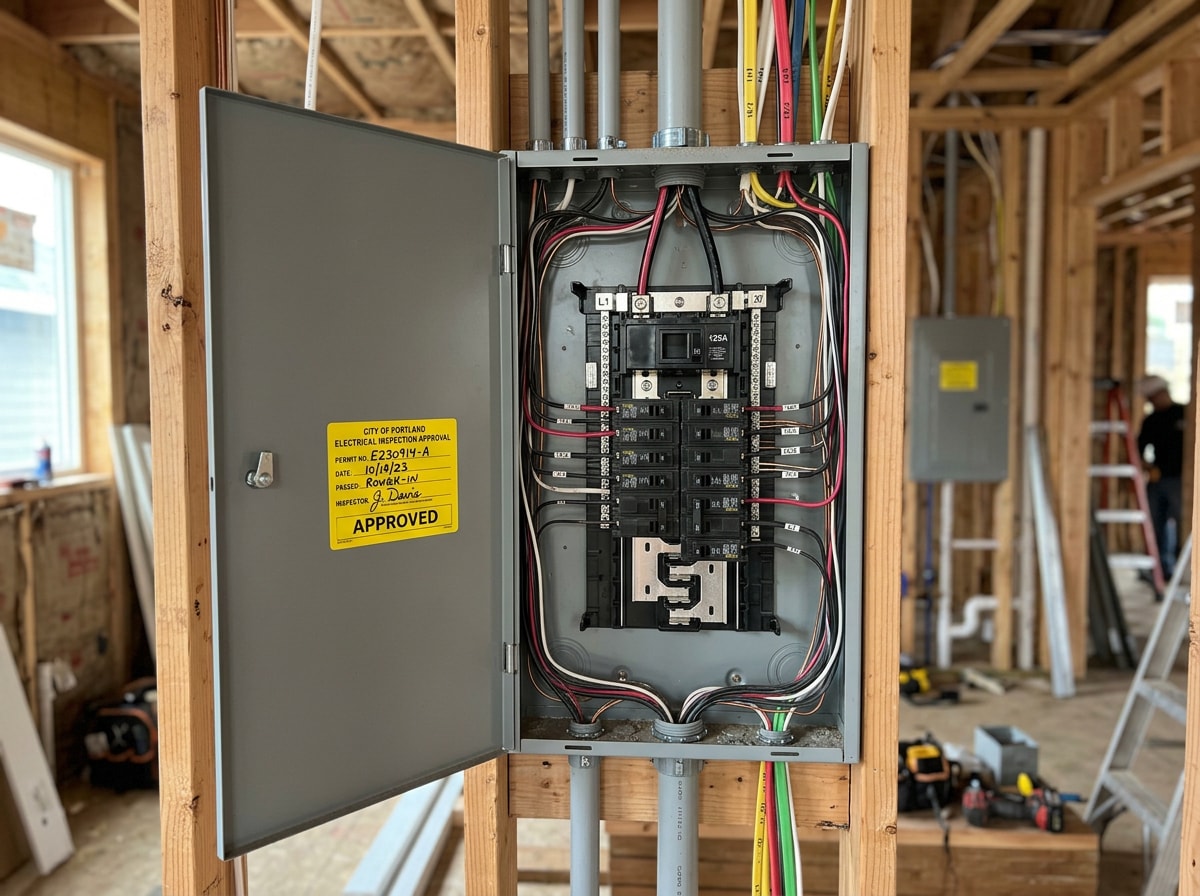
Working across the county, we see this variance firsthand every time we pull an electrical permit tied to a remodel. A city inspector in one jurisdiction wants a single-line diagram for a subpanel; another wants load calculations attached up front. Neither request is wrong, they're just different local interpretations of the same state code.
ADU conversions add another layer, since garage-to-ADU and new ADU builds almost always need new circuits, subpanels, or service upgrades. Our ADU contractor team coordinates that electrical scope directly with licensed C-10 partners, and our ADU permitting and compliance page walks through how that permit sequencing actually works city by city.
Commercial tenant improvement work follows a similar pattern. Office buildouts, restaurant conversions, and retail remodels typically need a C-10 sign-off on the electrical permit even when a general contractor is managing the overall build. See our Orange County service area page for city-specific project examples.
Can a Dual-Licensed GC Self-Perform Electrical Work?
Yes. If a contractor legitimately holds both the Class B and C-10 classifications, nothing in state law forces them to subcontract the electrical scope to another company. Self-performing is a business decision at that point, not a legal requirement.
Plenty of dual-licensed contractors still choose to subcontract selectively, even with both licenses in hand. Specialized electricians often move faster on complex panel or service-upgrade work, and subcontracting shifts certain liability and insurance exposure off the GC's policy. On larger commercial jobs with heavy electrical loads, that trade-off usually favors bringing in a dedicated electrical sub rather than self-performing everything in-house.
Choosing Who to Hire for Your Project
The right hire depends on project complexity, permit requirements, and how much liability you're comfortable carrying as the property owner.
| Project Type | Best Fit |
|---|---|
| Light fixture or outlet swap, existing wiring | Handyman exemption may apply (under $1,000, no permit) |
| Whole-house remodel with electrical bundled in | Dual-licensed GC or GC + C-10 subcontractor |
| New ADU, garage conversion, panel upgrade | C-10 electrician required, GC coordinates the rest |
| Commercial tenant improvement | C-10 sign-off required on the electrical permit |
For anything that touches a whole-house scope, our whole house remodeling team coordinates licensed electrical subs as part of the build from day one. If you're not sure which category your project falls into, get a free estimate and we'll walk through the licensing path before anything is scheduled.
Why These Licensing Rules Exist: Electrical Safety
These classifications aren't bureaucratic box-checking. OSHA's electrical construction standard addresses electrical safety requirements necessary for the practical safeguarding of employees involved in construction work, divided into four major divisions. Electrocution remains one of construction's most consistently fatal hazards, which is exactly why a dedicated federal standard exists around it.
Faulty wiring and overloaded circuits are a well-documented hazard in older housing stock, and Orange County has plenty of homes built well before current code cycles. Licensed C-10 electricians train specifically to catch those hazards during rough-in and final inspection, which is the whole point of keeping this work gated behind a trade license instead of a general one.
Key Takeaways
So, can a general contractor do electrical work in Orange County? Yes, but only within tight limits unless they separately hold a valid C-10 license. Incidental tasks tied to a bigger project may qualify under BPC 7059; anything standalone, permitted, or over the handyperson threshold needs a licensed electrician.
Don't skip the local permit step either. Each Orange County city reviews electrical scope a little differently, and that detail matters as much as the license itself. The team at DQB Team scopes the licensing path before the first permit application goes in, not after. Reach out for a free estimate to confirm the right approach for your project.
FAQ
Can a general contractor do electrical work in Orange County?
Only in a limited way. Without a C-10 license, a general contractor can perform electrical tasks that are genuinely incidental and supplemental to a larger construction contract under BPC 7059. Standalone wiring, panel, or circuit work requires a C-10 license or a licensed subcontractor.
Can a handyman do electrical work in California?
Yes, but only within narrow limits. Under the current $1,000 handyperson exemption, an unlicensed person can replace existing fixtures like outlets and switches on existing wiring, as long as the job needs no permit and no employees are hired.
Do you need a C-10 license to do electrical work in California?
Generally yes. Any electrical work beyond the small-dollar handyperson exemption requires a C-10 license, whether performed by a standalone electrician or by a general contractor who separately holds that classification.
What's the difference between a general contractor and a handyman?
A general contractor holds a formal state license covering large-scale, multi-trade construction and, with proper qualification, can oversee or self-perform bigger electrical jobs. A handyman works under California's dollar-capped exemption and can't take on permitted or complex electrical work.
Can a general contractor pull an electrical permit in Orange County?
It depends on the scope. A GC can often pull a combined building permit that includes electrical work performed by a licensed C-10 sub. Standalone electrical permits generally need to be pulled under the C-10 license itself.
How much electrical work can a GC do without a C-10 license?
There's no fixed dollar figure in the statute itself. The legal test is whether the electrical task is essential to completing the larger project the GC is already licensed for, not a specific invoice amount.